Fed
0 to 4 hours
Blood sugar rises, then falls
Your body is digesting your last meal. Blood sugar and insulin rise after you eat. Then they begin to fall over the next few hours.
Fasting timer for Android
A fasting timer built for real life. Ate something? Tap I ate and your fast restarts from that moment.
 Coming soon
Now in closed testing on Google Play. For adults 18 and over.
I ate
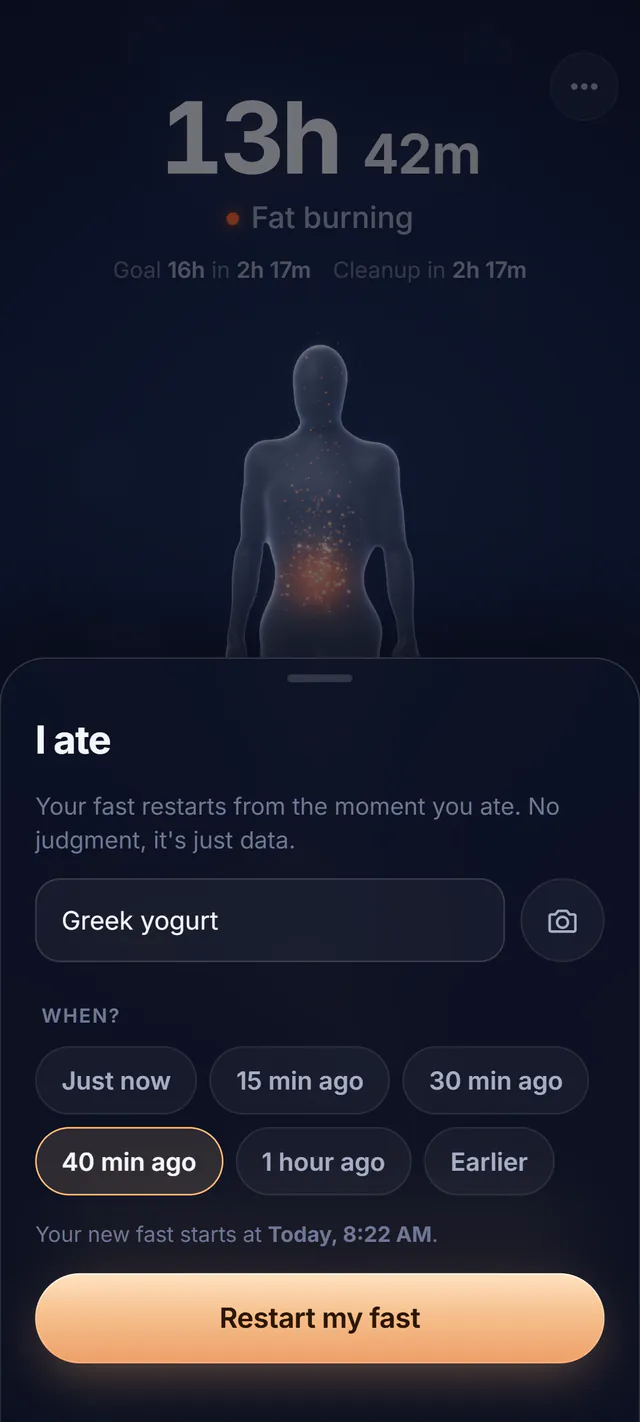
Most fasting apps treat a snack like a failure. FastWithin treats it like data.
Changed your mind? Undo it within 10 seconds. Want to remember what it was? Add a note, like Greek yogurt.


Kitchen closes
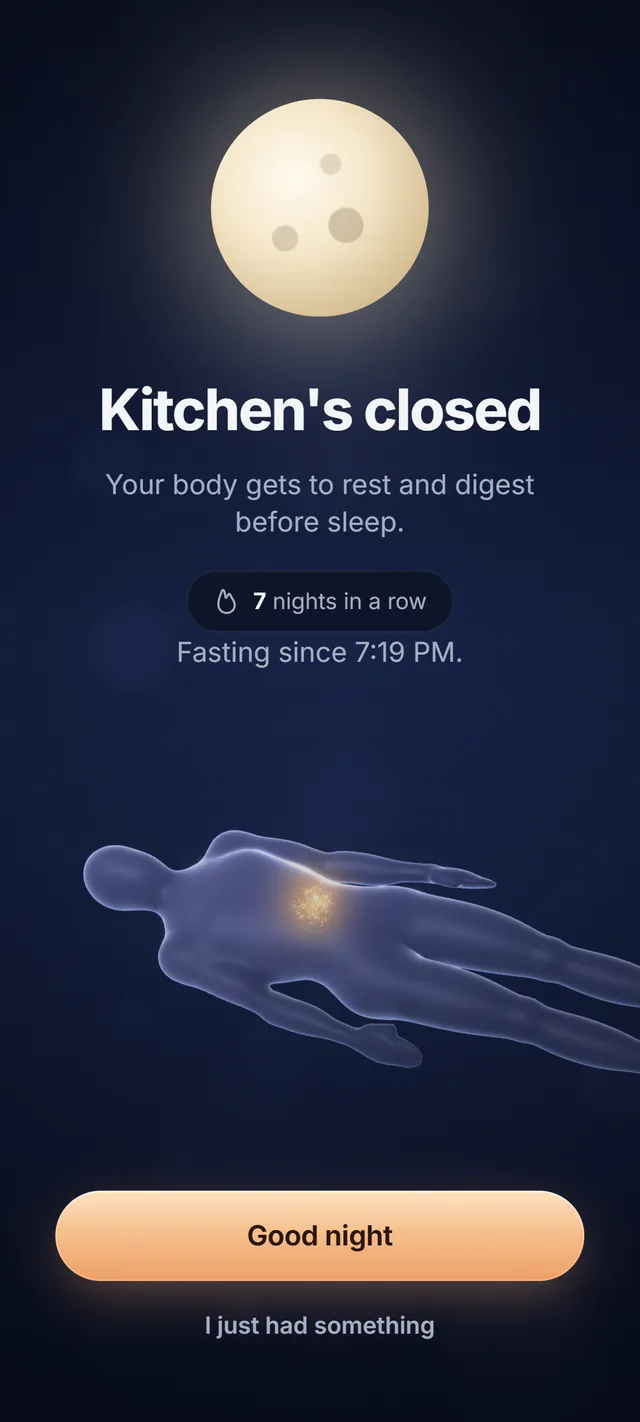
Set your bedtime (weeknights and weekends can differ) and FastWithin closes the kitchen 2, 3 or 4 hours before bed.
Why before bed? The app shows what research suggests about sleep, heartburn and overnight blood sugar, with the studies behind it. Some of those studies are small, and results differ from person to person.
Honest body zones
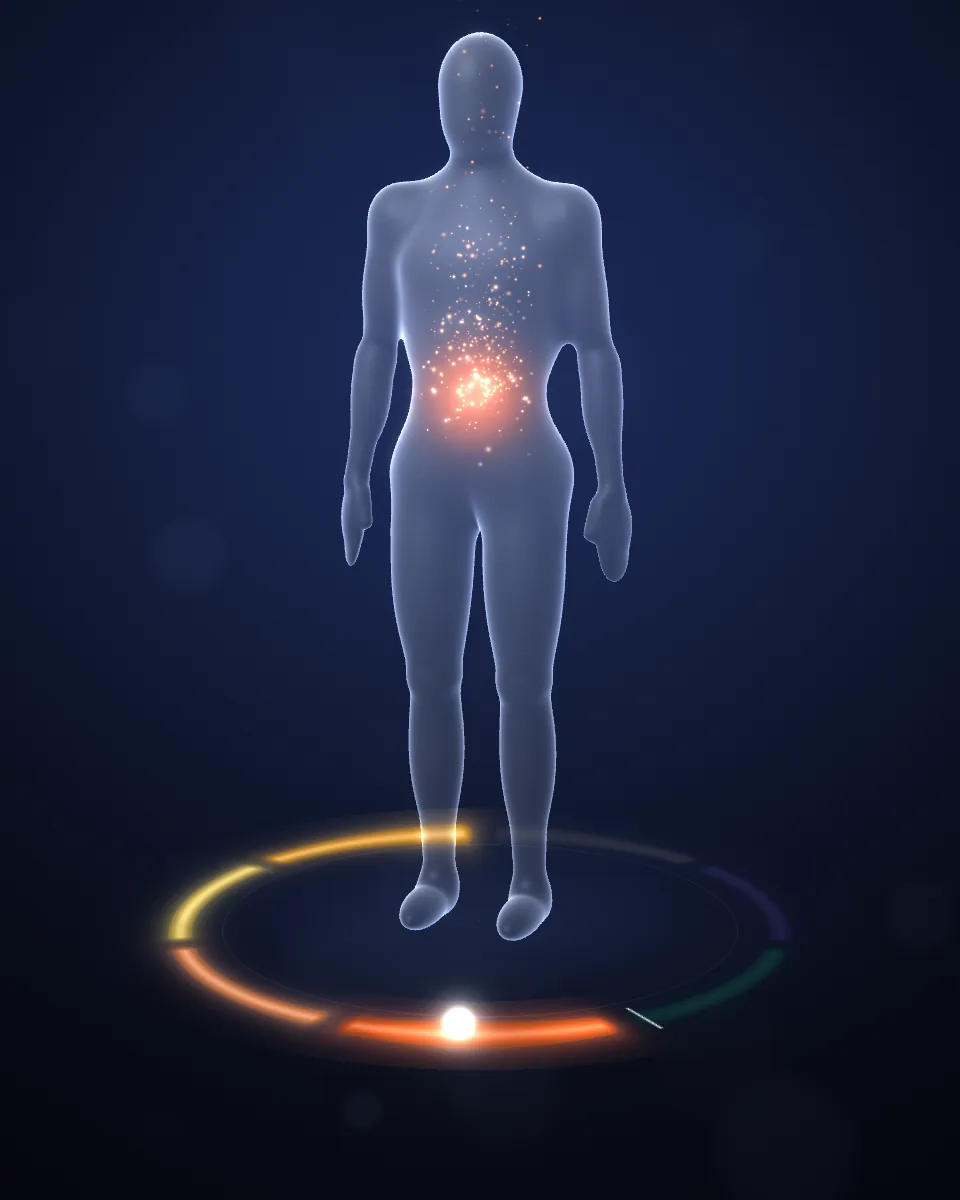
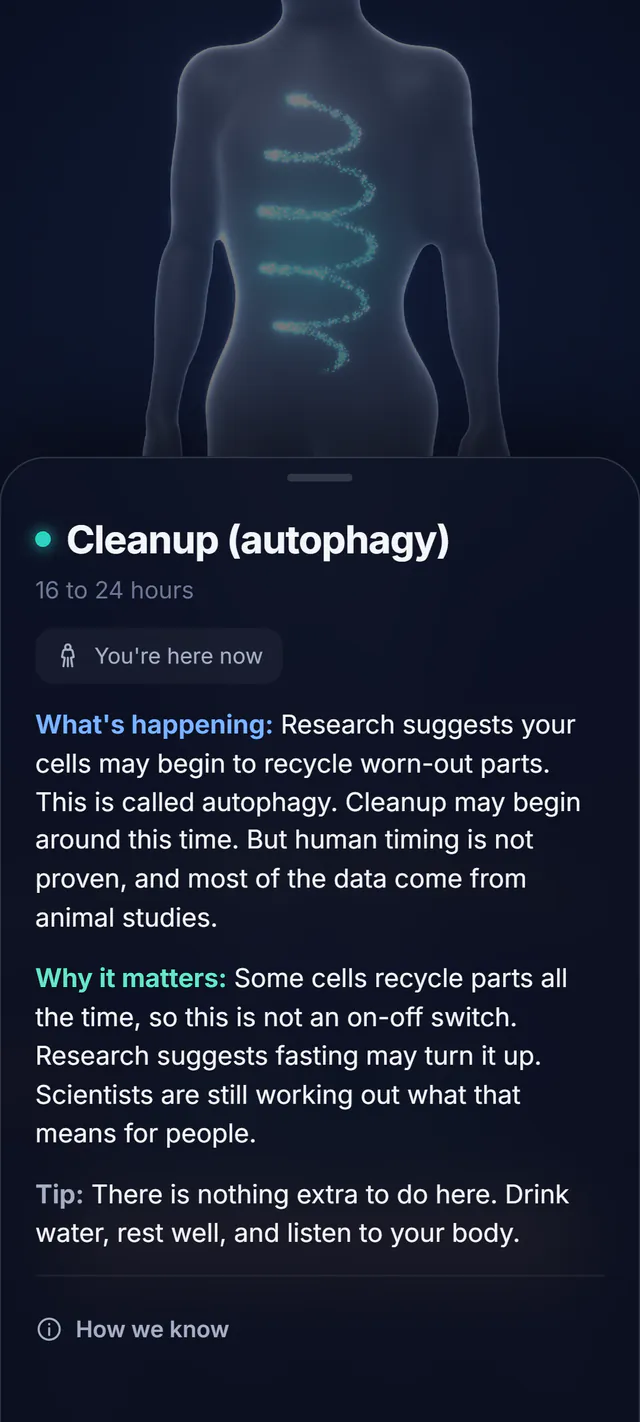
A cinematic 3D body shows what research suggests is going on inside as you fast. Each zone says what is happening in plain English, why it matters, one practical tip, and how we know.
Swipe the timeline to see what's ahead, or tap any part of the ring to fly to that zone.
0 to 4 hours
Blood sugar rises, then falls
Your body is digesting your last meal. Blood sugar and insulin rise after you eat. Then they begin to fall over the next few hours.
4 to 8 hours
Leaning on stored sugar
Your meal is mostly absorbed. Insulin keeps falling. Your liver releases stored sugar (glycogen) to keep your blood sugar steady.
8 to 12 hours
Stored sugar may run lower
For many people, the sugar stored in the liver runs lower around now. The body starts to pull more energy from fat. The full switch to fat and ketones (a fuel made from fat) often comes later, between 12 and 36 hours.
12 to 18 hours
Fat use may climb
For many people, the body now uses more fat for fuel. The liver makes ketones from fat, and ketone levels begin to rise (early ketosis). At first, the rise is small.
16 to 24 hours
Cleanup may begin
Research suggests your cells may begin to recycle worn-out parts. This is called autophagy. Cleanup may begin around this time. But human timing is not proven, and most of the data come from animal studies.
24 to 48 hours
Ketones climb higher
Ketone levels usually keep rising as your body relies more on fat. In studies of healthy men, growth hormone release went up during fasts of two days or more.
48+ hours
Talk to a doctor first
Fasts this long can cause dehydration in some people. They can also lower blood minerals called electrolytes. Eating again too fast after a long fast can cause a serious problem called refeeding syndrome.
Every zone card in the app has a "How we know" note with real sources: NIH pages and peer-reviewed studies. We say "research suggests" and "may" on purpose, we tell you when the evidence comes from animals, and we never promise weight loss or cures. The hours are ranges, not exact times, and the zones overlap.
Medical references describe how blood sugar and insulin rise after a meal in healthy adults. Blood sugar then comes back down over several hours, and insulin release drops with it. How fast this happens varies from person to person and meal to meal.
Medical references call the time from about 4 to 6 hours after a meal the postabsorptive state. Then the liver supplies most of your blood sugar, mostly from stored glycogen. In one study of healthy adults, insulin was much lower at 24 hours than at 4 hours. Timing varies from person to person.
A review puts the full switch at about 12 to 36 hours, depending on your liver's sugar stores and how active you are. In healthy adults, about half of the sugar released into the blood after an overnight fast was newly made, not taken from storage. So stored sugar is already running lower by then.
In one small study, ketones were a little higher after an 18-hour fast than after a 12-hour fast. In another study of healthy adults, ketones were still low at 4 hours and clearly higher at 24 hours. A review says the switch to fat and ketones usually comes after about 12 hours. Size and timing vary by person.
Most of the evidence comes from animals. In mice, autophagy rose in several organs after about 24 hours without food, but it varied by organ. In one small human study, a blood-cell gene linked to autophagy was higher after an 18-hour fast. That is a clue, not proof. A review says the exact timing of effects like autophagy is still largely unknown.
Two small studies of healthy men found higher growth hormone release during fasting. It was about 5 times higher on the second day of a fast (9 men) and higher during a 5-day fast (6 men). In another study, ketones were about 4 times higher at 48 hours than at 24 hours.
In a chart review of 768 medically supervised fasts of 2 days or more, tiredness, nausea, headache, and near-fainting were common. Two people needed hospital care, one for dehydration and one for low blood sodium. Refeeding syndrome is mainly described in people who are malnourished or who went more than 5 days with little or no food. How likely it is after shorter fasts is not well known.
Research suggests that eating close to bedtime may affect a few things. Here is what studies have found so far. Some of these studies are small, and results can differ from person to person.
The safety text in the app (pregnancy, nursing, under 18, diabetes, medicines, eating disorders, long fasts) rests on these.
Built for real life
Tap Start fasting now and go. Everything else is there when you want it.


Pick 12, 14, 16, 18, 20, 24, 36 or 48 hours.
Zone changes, your goal, the kitchen cutoff, water breaks and a weekly look back. Each one has its own switch, and they keep working after your phone restarts.
Your longest fast this week, goal streak, kitchen streak and a weekly chart.
Correct times across time zones and daylight saving changes.
Dark mode first, light mode too, large text support, and a 2D body for phones that prefer it.
Swipe the timeline to preview later zones, or tap any part of the ring to fly to that zone.
Fair pricing
No paywall before your timer. Plus is optional, and cancelling takes one tap.
$0
No account. No ads. No paywall before your timer.
Optional. Adds:
We remind you 2 days before any trial charge. Manage or cancel in Settings takes you straight to Google Play in one tap.
Private by design
Your fasting history stays on your phone. FastWithin has no ads and no tracking.
Open the app and start. There is nothing to sign up for.
Your fasts, meals, notes, bedtime and settings are stored on the device. Notifications are scheduled on the phone too.
No ads, and no analytics or tracking SDKs in the app. This website uses no cookies.
Photo I ate, in Plus, sends a photo over HTTPS to our AI helper (it uses Google's Gemini) only to name the food. FastWithin does not store it. Skip it and nothing leaves your phone.
Questions
Tap I ate and your fast restarts from that exact moment. Forgot to log it? Pick 40 minutes ago, or an earlier time, and the math fixes itself. Changed your mind? Undo it within 10 seconds. Every fast and every restart stays in your history, with no judgment.
The core is free for good: the timer, I ate, Kitchen closes, every zone with its sources, and the 3D body. There is no paywall before your timer. FastWithin Plus is optional: $4.99 a month, $29.99 a year with a 7-day free trial, or $59.99 once for lifetime. We remind you 2 days before any trial charge, and Manage or cancel in Settings takes you straight to Google Play in one tap.
No. There is no account and no sign-up. Your fasting history stays on your phone.
No. FastWithin is a timer and education app, not medical advice. Fasting is not right for everyone. Talk to a doctor first if you are pregnant or nursing, have diabetes, take medication, have a medical condition, or have a history of an eating disorder. FastWithin is for adults 18 and over.
The hours are ranges, not exact times, and the zones overlap on purpose. Your timing depends on your last meal, your activity and your body. We say "research suggests" and "may" on purpose, we tell you when the evidence comes from animals, and we never promise weight loss or cures. Cleanup (autophagy) is the least certain zone: most of that research is in animals, and human timing is not proven. Every zone has a "How we know" note with its sources, and you can read them here.
Photo I ate is optional and part of Plus. The photo is sent over HTTPS to FastWithin's AI helper, which asks Google's Gemini to name the food and sends the name back. FastWithin does not store the photo. Google's service may keep what it receives for a limited time under its own terms, so please don't photograph people or anything private. You can always type what you ate instead. The details are in the privacy policy.
FastWithin is an Android app. It is in closed testing on Google Play now, so the Google Play badge on this page is not a link yet. It will link to the listing when the app launches.
Open Settings and tap Delete all my data, or uninstall the app. There is no account, so there is nothing to delete on our side. The delete data page has the details.
FastWithin is an Android fasting timer, now in closed testing on Google Play.
Coming soon